ISAScrawler
At the Intelligent Sensor-Actuator-Systems lab, a group of small caterpillar robots was meant to explore collaborative swarm behavior: machines that crawl over terrain in groups and solve tasks together. The existing prototype had accumulated enough mechanical and electrical problems that efficient operation was impossible, so my Studienarbeit became a ground-up redesign.
# what was wrong
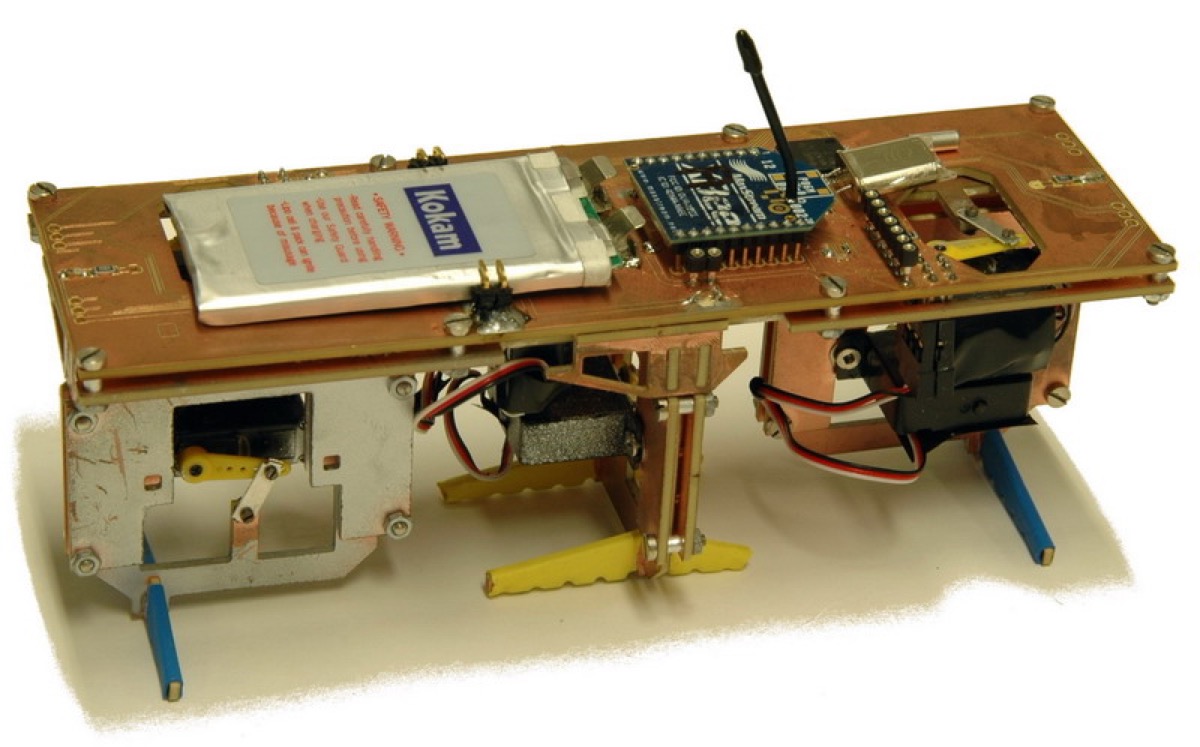
The predecessor fought itself: open-loop motors with no position feedback, a microcontroller per limb, joints that shed their ball bearings, and a tethered power supply. Every subsystem needed redesign, and the fixes only worked together, so it became a new robot.
# the redesign
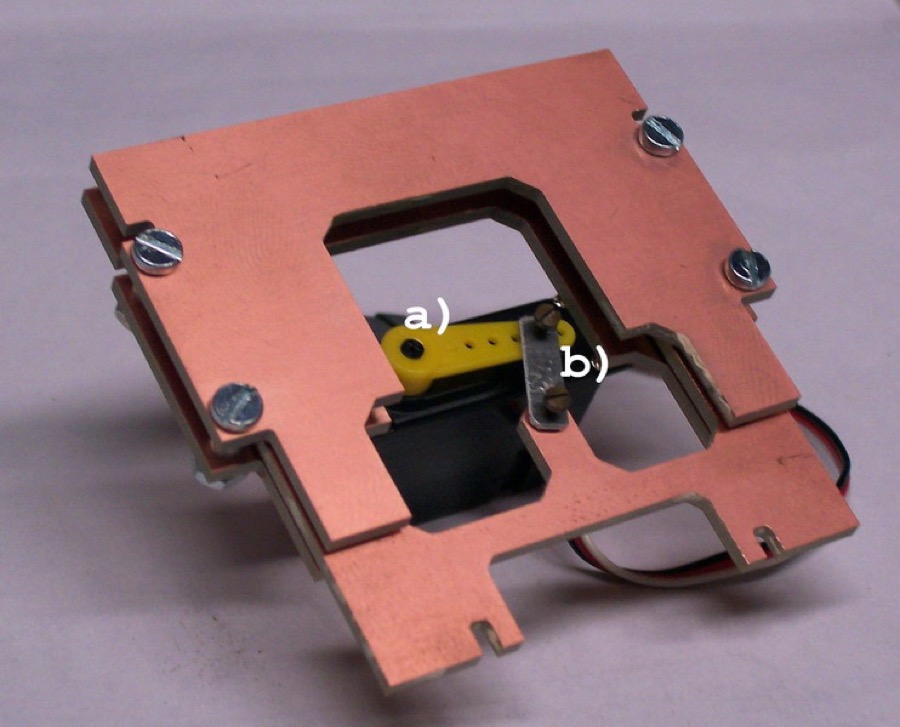
The frame is CNC-milled copper-clad PCB material: structure and circuit board in one. The joints became a sandwich construction: three plates with enclosed ball-bearing races, so the bearings physically cannot fall out, driven by 4.7-gram positional micro servos. One microcontroller replaced the previous cluster, a new radio module made communication bidirectional, and a lithium-polymer cell finally cut the cable. The firmware was rewritten from scratch: besides manual and per-servo control, the robot accepts target coordinates and walks a straight computed path on its own: dead reckoning only, no feedback about drift yet.

# looking back
It was the first project where I built the whole stack myself (mechanics, boards, radio protocol, firmware), and where I learned that the second version of anything is mostly an apology to the first. The crawler above is rebuilt in code from the thesis drawings, walking its original gait.